


Humanity Must awaken

‘Humanity must awaken’an interview with Nikita Zigura about his land art ‘New Renaissance’
In Italy, near the town of Castell’Arquato in the Emilia-Romagna region, a large-scale land art work titled New Renaissance has appeared, created by a Ukrainian artist Nikita Zigura. The shape of Leonardo da Vinci’s Vitruvian Man, with the symbol of pacifism superimposed on it, can be seen both from the hill where the historic town is located and from the 14th-century fortress.
What is this work about? What ideas does it seek to draw attention to? What does the artist mean by the concepts of pacifism and humanism?
We discussed this and much more in an interview with the creator of New Renaissance, Nikita Zigura.
Honestly speaking, your new work, The New Renaissance, is striking at first glance. Even a single image of it is enough to make you want to examine it more closely and learn more – about the project itself, its context, and the meanings embedded within it. That's exactly what I'd like to talk to you about today. But let's start at the beginning - with the form itself. The work, spanning 60 metres, is based on Leonardo da Vinci's Vitruvian Man, over which you have superimposed the peace symbol. Why did you choose this particular combination?
Once, on a beach in Nice, I saw a pebble composition created by a street artist. At its centre was the peace symbol, while around it, in different languages, were words associated with this idea – peace, love, freedom, and so on. The work reminded me of the importance of these values and of the universal power of the peace symbol, especially in contrast to the propaganda that seeks to justify violence, glorify killing, or portray war as something sacred. Later, while thinking about a concept for the Italian hills, I found myself visually bringing together these two symbols from different eras. On the one hand, there is Leonardo's Vitruvian Man – an image of harmony, of the almost ideal human being, the pinnacle of creation. On the other, there is the peace symbol, born out of the horrors of the nineteenth and twentieth centuries, when humanity gradually came to understand that endless, senseless wars and conflicts must be restrained.

‘New Renaissance’, land art by Nikita Zigura. Photo: Dmytro Nazarovskyi
By rethinking today's challenges – wars, conflicts, and the fragmentation of society – this project seems to call for a new kind of humanism, one centred on the value of human life, peace, and nature. It evokes the vision of an ideal world. At the same time, it is difficult to speak about the humanism of the Renaissance without mentioning Niccolò Machiavelli. As a political thinker and statesman, he did not reject the idea of war; on the contrary, he wrote about the art of warfare and famously argued that "there is no avoiding war; it can only be postponed to the advantage of others." He also wrote extensively about the mechanisms of influencing the masses and the means of maintaining political power. Isn't there a risk that, in striving for humanism in its noblest form, placing the human being at the centre of the universe may encourage some political leaders to become even more self-centred – to see themselves as possessing a unique authority? And that, in turn, could lead to even more wars and conflicts?
That’s a very good question. However, my intention is not to propose a return to the past. Rather, the idea is about the cyclical nature of history and its development. In the concept for this project, I tried to outline the key differences - or rather, the extensions - to the ideas of the Renaissance. The difference lies in a fundamental approach to the value of all forms of life – whether it is a human being, a tree, or an entire ecosystem. As for Machiavelli, he was thinking within the scale of his own time and the weapons that existed then. When we consider the possibility of a global nuclear war between superpowers, I don't think Machiavelli's arguments about an opponent’s advantage still apply. In the event of a global nuclear war, there would be no advantage for either side. Given this reality, such a war is in no one's interest. This means that conflicts must be resolved according to entirely different principles. I don't think this concept belongs to some idealized world; rather, it reflects a sober understanding of the realities we face today. As for the medieval wars when people were mobilised and forcibly sent to the front lines, and when countless died for reasons no one truly understood – this is a nightmare induced by the narcotic of propaganda, one from which humanity must awaken as soon as possible.
How do you understand humanism and pacifism in practical terms? Are these ideas not utopian by their very nature, considering the entire history of our world...?
We are taught from childhood that civilisation developed through armed conflicts, and that this is somehow part of human nature. But a lion, after it catches and eats an antelope, does not suffer from psychological trauma. Human beings who return from war, however, often require psychological support, and many struggle to find themselves again in normal (peaceful) life. I am not even mentioning the numerous suicides among former soldiers. Based on this, war cannot be considered a natural component of human existence. As for pacifism, it is simply a matter of logic. War is a profitable business, and it is not the soldiers who profit from it. This applies to every conflict on the planet without exception. Moreover, no one today wages war using every possible means with the goal of completely destroying the opponent, because that would inevitably lead to the destruction of all life on the planet. Therefore, other mechanisms exist alongside total war aimed at annihilation, which means that when necessary, negotiations are also possible. And as long as people are influenced by propaganda, fear, and hatred, it remains possible to keep sending them into the meat grinder of endless warfare. To sum up, humanism is, to some extent, a utopian ideal that requires education and spiritual development. Pacifism, on the other hand, is something much more concrete and practical, with a clear logical foundation.‘

New Renaissance’, land art by Nikita Zigura. Photo: Dmytro Nazarovskyi
Returning to the work itself, what is striking is not only its form and content, but also the place where it was created. Why did you choose this particular location – near the Italian town of Castell’Arquato in the Emilia-Romagna region? How did the negotiations with the landowners take place? Did they immediately support your idea?
Several years ago, I had an exhibition at an art gallery in this wonderful historic town, and I visited its 14th-century castle. From the main tower of the castle, there is a unique view of the surrounding landscape. It was at that moment that the idea of creating a large-scale land art project was born. Rita Zilocchi, the owner of the gallery, arranged discussions with local farmers about the possibility of realising this project. They had only two conditions: no flags and the use of environmentally friendly materials. I was completely comfortable with these requirements, as they reflect exactly what I aim to express through my art.
Speaking about the sustainability of materials – eco art is one of the leading themes in your work. What specific materials were used to create this piece?
Yes, one of the areas of my practice involves projects related to environmental issues, but there should not be necessarily exclusively eco-friendly materials. Some projects address these concerns through the use of non-ecological materials – for example, plastic or household waste – while others symbolically represent the global scale of the situation, even though I use traditional sculptural materials such as stainless steel, brass, and bronze.
However, for this particular work (New Renaissance), I deliberately used only environmentally friendly components. I created the paint myself, using charcoal powder, water, and starch as the base. I believe this field will now produce a better harvest after my drawing)
How long did the work on this land art project take, and what turned out to be the most challenging part of the creation process?
The entire process, from the initial marking out to the final touches, took 12 days. At first, I worked together with my brother, Egor Zigura. Once the main creative decisions had been resolved, Egor left, and I was assisted by local volunteers – Ukrainians who, interestingly, had received refuge in Italy precisely because of their pacifist beliefs. Thanks to this, we worked quickly and efficiently. The most challenging part was enduring the Italian heat, as temperatures during this time of year can reach up to 35°C. Another difficulty was getting up at 6 am every morning and working hard until the evening. The entire project was created on my own initiative and with my own resources, but the understanding that such artistic statements are especially relevant right now gave me additional strength and inspiration.
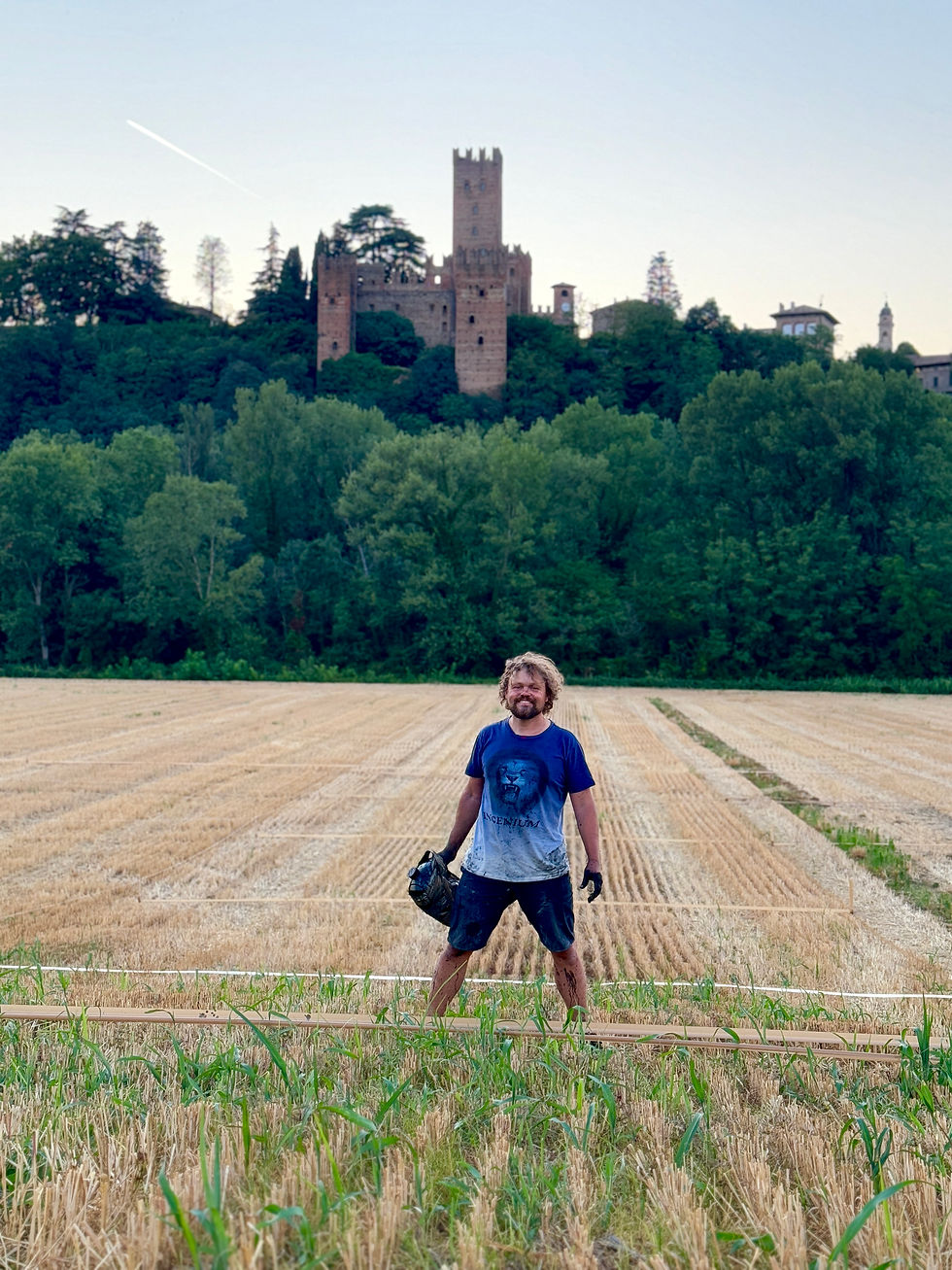
Nikita Zigura at work on ‘New Renaissance’
This work is a continuation of your project Peaceful Sky, which you have been working on since 2022. As part of this project, you have already created a series of land art works in Denmark and France. Among them are the ‘shadows’ of the Ukrainian aircraft Mriya, an unmanned aerial vehicle, a Russian fighter jet, Shahed-type drones, and even the aircraft of Antoine de Saint-Exupéry. This series, as well as the concept behind it, leaves a powerful impression. Could you tell us more about this project and what further plans you have for its development?
Peaceful Sky began as a project of reflection on the invasion of Ukraine. I depicted the shadows of military aircraft as the shadows of birds of prey flying over a field where hares are running. It is a kind of instinctive fear, perhaps inherited from our animal past. After all, throughout history, the sky has always represented hope; all our greatest dreams and aspirations are connected with it. Because, in the end, it is not so important what is happening here on Earth – the sky should remain clear, and then everything will work out. Gradually, however, I began to introduce new structural layers into the project. For example, in the work featuring Antoine de Saint-Exupéry’s aircraft, I brought together the past of France and the present of Ukraine within a single composition. It became a dialogue between eras, a dialogue between generations. What is particularly fascinating about Exupéry is that he was an absolute idealist and humanist, yet he could not remain on the sidelines of the war. I think that, at that time, the ideas of pacifism had not yet become as relevant as they did after the mass production of nuclear weapons. I certainly have plans for the future. I'm currently working on new eco-art projects, and I hope to create another piece in Provence soon
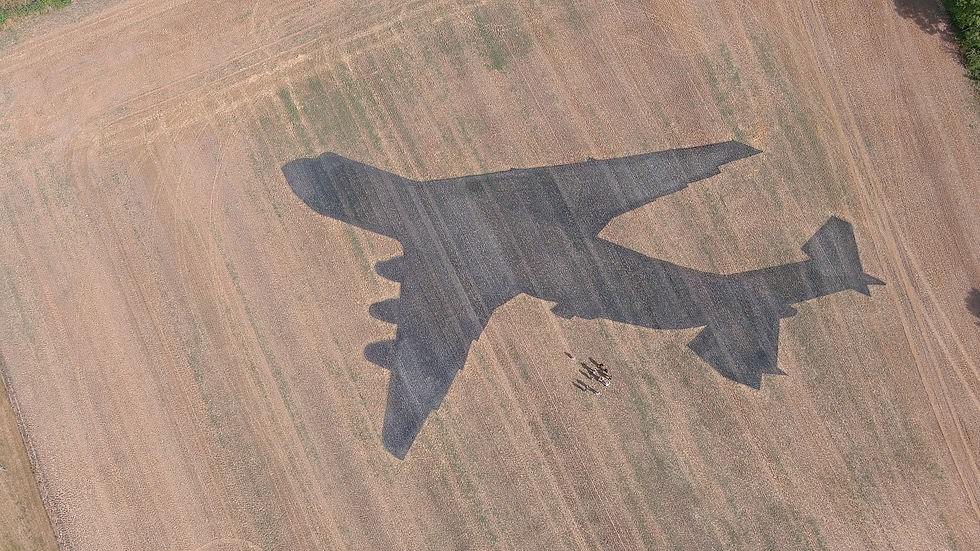
.The ‘shadow’ of the Ukrainian aircraft Mriya, ‘Dream № 225’, land art, ‘Peaceful Sky’ projectBogense, Funen Island, DenmarkPhoto provided by the artist

The ‘shadow’ of the aircraft of Antoine de Saint-Exupéry, ‘Captain of the birds’, land art,
‘Peaceful Sky’ project
Provence, France
Photo provided by the artist


Comments