


Eco Artists You Should Know -Before the Planet Changes Without Us

What makes eco artists compelling isn’t that they “use recycled materials” or “care about sustainability.” It’s that they treat the Earth not as a theme, but as a collaborator. Soil becomes pigment. Grass becomes text. Ice becomes a ticking clock. The gallery becomes an ecosystem.
Here are some artists who aren’t just responding to the climate crisis — they’re composing with it.

Fiona Campbell — When Art Behaves Like a Landscape
Fiona Campbell’s work doesn’t sit still. It grows, shifts, fades, dries, cracks, returns.
Her sculptures and installations draw on ancient natural forms — sea life, erosion patterns, biological structures — but they’re not nostalgic. They feel like fragments from the future, as if archaeologists have uncovered relics from a world that hasn’t happened yet.
What makes Campbell’s work quietly radical is its patience. In a culture obsessed with immediacy, she makes pieces that demand time. You don’t just look at them — you wait with them.

Rosalind Lowry — Working With Fragile Places
Lowry’s practice sits delicately inside vulnerable landscapes — peat bogs, wetlands, endangered ecosystems.
Rather than imposing her will on these spaces, she responds to them. Her sculptures often feel like temporary visitors, acknowledging that the land is older, stronger, and more important than the artwork itself.
It’s a quiet, respectful form of environmental activism — one that listens before it speaks.

Precious Okoyomon — The Poetics of Overgrowth
Precious Okoyomon makes work that behaves like an emotional ecosystem. Vines spill across gallery floors. Soil sits where marble should be. Poetry exists not on walls but inside living installations.
Their work blurs the boundaries between grief, colonial history, queerness, nature and regeneration. Plants don’t become metaphors — they become witnesses.
In Okoyomon’s world, ecology is never neutral. It’s political, tender, and deeply alive.

Olafur Eliasson — Turning Climate Into Experience
Eliasson doesn’t want you to understand climate change. He wants you to feel it.
By bringing melting glacial ice into city squares or creating immersive weather systems inside museums, he collapses the distance between “global warming” and “your body standing here right now.”
His installations don’t lecture. They confront. They make the invisible visible — and once you’ve felt it, you can’t un-feel it.
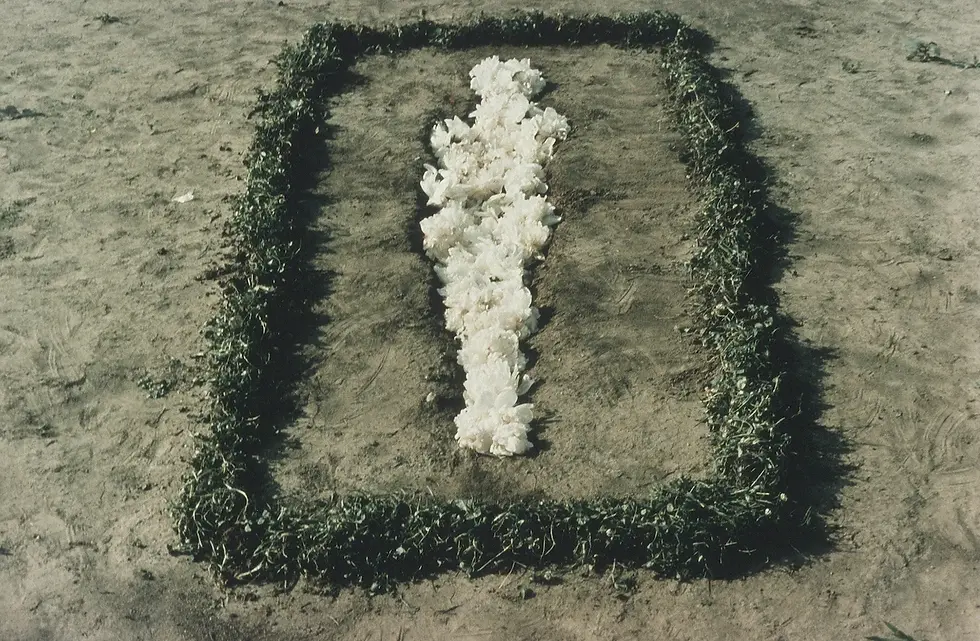
Ana Mendieta — The Body Returns to the Earth
Decades before “eco art” became a category, Ana Mendieta was already making some of its most haunting work.
By imprinting her own body into landscapes — sand, soil, fire, water — she created fleeting silhouettes that spoke of belonging, disappearance, femininity, exile and the natural world.
Her work reminds us that environmental destruction isn’t abstract. It’s personal. Our bodies are made of the same stuff as the ground beneath our feet.

UGO RONDINONE
Exploring the tension between what is natural and what is man-made, Swiss artist Ugo Rondinone created Seven Magic Mountains in 2016, installing the work in the Mojave Desert just ten miles outside Las Vegas.
The towering, brightly coloured stacks — each rising nearly ten metres high — stand in striking contrast to the muted orange landscape around them, subtly reflecting humanity’s imprint on the natural environment. The installation encourages viewers to pause within the open desert, drawing a quiet comparison between untouched wilderness and the expanding urban world nearby. In 2022, Rondinone revisited this concept with Doha Mountains, placing similar sculptural forms against the dramatic backdrop of Doha’s skyline, where the vivid totems now stand amid glass towers and dense city life.

JUSTIN BRICE GUARIGLIA
Justin Brice Guariglia’s practice sits at the intersection of art, technology, and environmental activism, using the visual language of road signage and public information systems to confront the realities of the climate crisis. By repurposing familiar motorway LED signs, his work turns tools of navigation and warning into poetic and political statements about the future of the planet.
Across projects such as Reduce Speed Now! and We Are the Asteroid, Guariglia presents urgent messages drawn from science, philosophy, and literature, often echoing the voices of thinkers and environmental advocates. Phrases that reference melting ice, ecological tipping points, and human responsibility appear in bold, flashing text, mimicking the tone of traffic alerts and emergency broadcasts.
But why eco art matters now? because eco art isn’t about saving the planet.
The planet will survive. What’s at stake is whether our way of living will. These artists don’t offer solutions. They offer something arguably more powerful: awareness, intimacy, awe, discomfort. They re-enchant the natural world at a moment when it’s easier than ever to forget it.
In their work, nature is not scenery. It is story. It is collaborator. It is protagonist.
And in a time of ecological collapse, that might be the most radical artistic move of all.


Comments